You’ve probably been told to pick one: Pilates or weights. But what if that’s exactly the wrong advice?
Pilates and strength training aren’t rivals; they actually work best together. Pilates builds the deep core stability, mobility, and control. It makes your lifts safer and more effective. Strength training provides the resistance your muscles need to grow and get stronger in ways Pilates alone can’t fully deliver.
Together, you get something far more powerful than either approach on its own – a body that’s strong, mobile, balanced, and resilient.
But simply mixing the two isn’t enough. Most routines miss the structure needed to truly maximise muscle activation, improve mobility, and avoid plateaus. That’s where a well-designed Pilates and strength training dumbbell workout comes into play.
So, how to combine Pilates with strength training without overcomplicating your routine, and actually see results?
In this guide, you’ll learn exactly how Pilates and strength training complement each other, and follow a full-body dumbbell workout for women, structured into three targeted blocks, so you can build lean muscle, improve stability, and train smarter in one efficient session.
Why Pilates and Strength Training Work Better Together
For decades, these two training styles were marketed as opposites. Pilates was "toning." Strength training was "bulking." Neither label was accurate. Both kept women from getting the results they were after.
Here's the reality:
Pilates builds strength using accurate and carefully controlled movements that activate deep muscles responsible for stabilization of the body often neglected in regular exercises. Indeed, studies have shown that training with Pilates for developing the stability of the core enhances the contraction speed, activation, and thickness of deep muscles (transversus abdominis and internal oblique).
Strength training, on the other hand, helps to develop muscle mass. In fact, a systematic review and meta-analysis proved that with an appropriate resistance training protocol, muscle strength can be increased by approximately 25% in women.
The combination will help design a perfect workout routine where all facets of fitness are taken care of. In other words,
-
Pilates prepares your body by activating the stabilizers, helping improve your body posture, and activating those muscles that heavy lifting exercises tend to overlook.
-
Lifting loads through strength training helps create overload, develop muscle mass, and boost the metabolic rate of your body at rest.
- The combined workout ensures joint protection, as Pilates focuses on dynamic strength development. What it does is enhance the ability of your body to support and stabilize joints during motion while balancing the muscular strength of your body such that it neither becomes weak nor stiff. Both of which make you prone to injuries.
Pilates is the base while strength training gives you the extra edge.
The result is a training approach that doesn't just change how your body looks; it changes how it moves, recovers, and performs every single day.
What Muscles Does Pilate Strength Training Target?
This workout is structured in three blocks, each targeting a specific muscle region before finishing with a core-focused rotation sequence.
|
Block
|
Focus
|
Muscle Groups
|
|
Block 1
|
Lower Body
|
Glutes, hamstrings, quads, calves
|
|
Block 2
|
Upper Body
|
Shoulders, back, chest, biceps, triceps
|
|
Block 3
|
Core
|
Deep abdominals, obliques, spinal stabilisers
|
Each block pairs one strength-focused exercise with two Pilates-inspired moves. The strength move builds power. The Pilates moves deepen muscle activation and increase time under tension. The key to building lean muscle without needing to go heavy.
What Fitness Equipment You'll Need
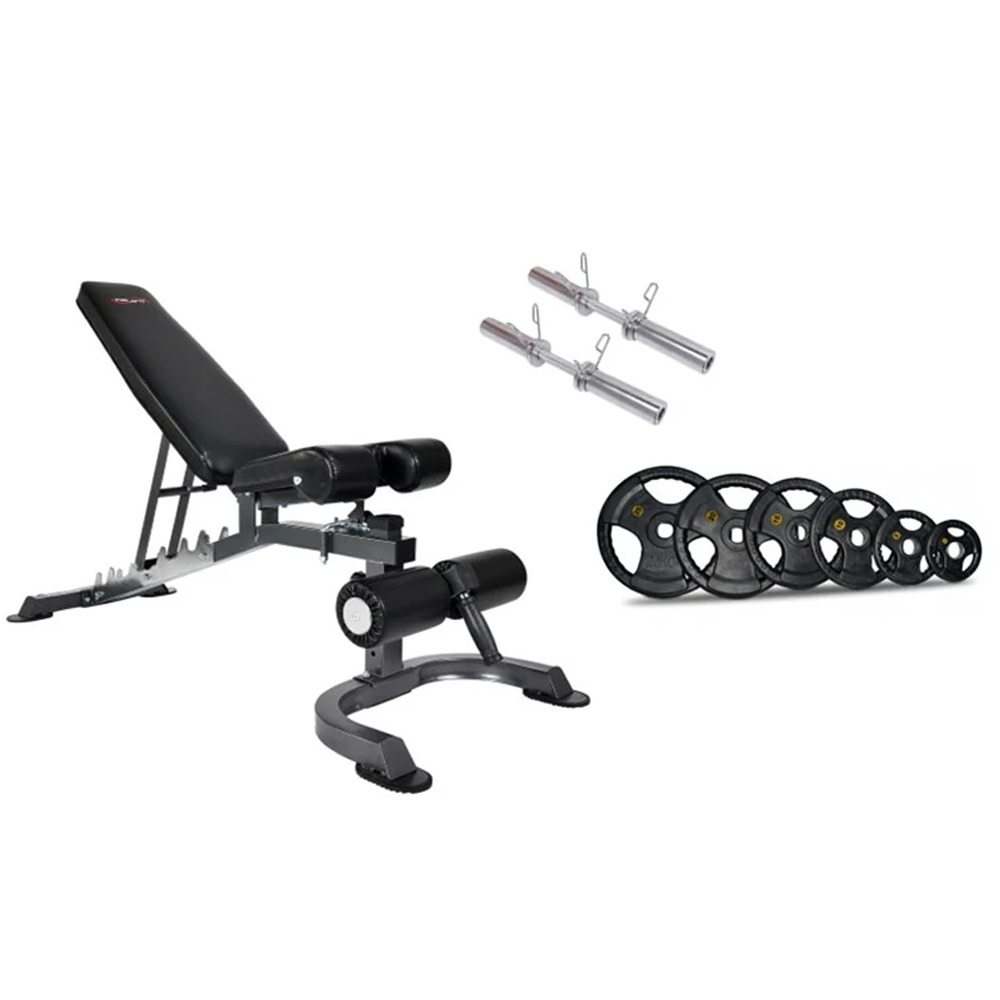
You don't need a full gym for this workout. Here's the equipment list:
|
Equipment
|
Recommended Use
|
Notes
|
|
Dumbbells
|
Strength exercises (presses, deadlifts, rows)
|
Start light to moderate. Increase weight as you build strength.
|
|
Flat Bench or Mat
|
Support for upper body and floor exercises
|
Bench increases range of motion; mat works well for core and floor-based Pilates movements.
|
|
Resistance Band
|
Glute activation and core tension
|
Adds extra resistance without heavy weights.
|
|
Pilates Reformer
|
Advanced Pilates-based training
|
Expands exercise variety and control.
|
How to use this workout:
Complete each block as a circuit. Perform all exercises in the block back-to-back. Rest 60 seconds then repeat for a second round before moving to the next block.
Total workout time: approximately 35–40 minutes.
Pairing Pilates with Strength Training: Full-Body Workouts for Women
Block 1: Lower Body (Glutes, Hamstrings & Quads)
This block opens with a hinge-pattern strength move before transitioning into Pilates-based glute and hamstring work to burn out the posterior chain and build deep muscular endurance.
1- Dumbbell Romanian Deadlift (Strength Move)

Muscles worked: Hamstrings, glutes, lower back, core
The Romanian deadlift is the anchor of this lower body block. It builds serious posterior chain strength; the hamstrings and glutes. Demands active core engagement throughout.
How to Perform:
- Stand with feet hip-width apart, holding a dumbbell in each hand in front of your thighs. Palms facing your body.
- Engage your core.
- Retract your shoulder blades.
- Hinge at your hips; pushing them back, and lower the dumbbells along the front of your legs, keeping your back flat.
- Lower until you feel a deep stretch in your hamstrings (just below the knee).
- Drive your hips forward to return to standing, squeezing your glutes at the top.
Sets & Reps: 3 sets of 10–12 reps
Form Tip: This is a hip hinge, not a squat. Your knees stay soft but mostly still. The movement comes from your hips and hamstrings, not your legs bending.
2- Hip Bridge (Pilates Activation Move)

Muscles worked: Glutes, hamstrings, spinal stabilisers, pelvic floor
The hip bridge is a Pilates staple. After the load of the deadlift, it isolates the glutes through a shorter, controlled range and demands precise spinal segmentation. The hallmark of Pilates movement.
How to Perform:
- Lie on your back with knees bent, feet flat on the floor hip-width apart.
- Press your lower back gently into the mat and engage your core.
- Drive through your heels to lift your hips toward the ceiling, creating a straight line from knees to shoulders.
- Squeeze your glutes hard at the top and hold for 2 seconds.
- Lower your hips slowly; vertebra by vertebra, back to the mat.
Sets & Reps: 3 sets of 15 reps
Form Tip: Don't rush the lowering phase. Rolling the spine down one vertebra at a time. This is what makes it a Pilates move, not just a glute raise.
3- Bridge Walkouts (Pilates Burnout Move)

Muscles worked: Hamstrings, glutes, core stability
Bridge walkouts extend the hip bridge into a dynamic hamstring challenge. Your core has to work overtime to keep your hips level as you walk your feet out and back. It becomes a much stability exercise as a strength one.
How to Perform:
- Begin in the top position of your hip bridge. Hips raised, glutes squeezed.
- Keeping your hips lifted, slowly walk your feet out one step at a time until your legs are almost straight.
- Then walk your feet back in to the starting position.
- That's one rep. Maintain hip height throughout.
Sets & Reps: 3 sets of 10 walkouts (5 steps out, 5 steps back)
Form Tip: If your hips drop to one side during the walkout, shorten your step length. Level hips are the priority.
Block 2: Upper Body (Shoulders, Back & Arms)
After the lower body block, you shift focus to the upper body. The strength move loads the pressing pattern; the Pilates moves address shoulder mobility, posture, and scapular control — areas most gym programmes completely ignore.
4- Dumbbell Shoulder Press (Strength Move)

Muscles worked: Deltoids, triceps, upper traps, core
The overhead press is the primary upper body strength driver in this block. It builds shoulder mass and pressing power while demanding core stability to protect the lower back.
How to Perform:
- Sit on a bench or stand with feet hip-width apart, holding a dumbbell in each hand at shoulder height, palms facing forward.
- Press both dumbbells overhead until your arms are fully extended — but don't lock your elbows.
- Lower the dumbbells slowly back to shoulder height.
Sets & Reps: 3 sets of 10–12 reps
Form Tip: Avoid arching your lower back as you press. Brace your core before each rep, as if someone is about to press on your stomach.
5- Pilates Chest Opener (Pilates Mobility Move)

Muscles worked: Chest, anterior shoulder, thoracic spine, rhomboids
The chest opener counteracts the forward-rounded posture that comes from daily life and pressing exercises. It's a controlled rotation and extension drill that improves thoracic mobility — something the Women's Health hybrid programme emphasises as critical for long-term shoulder health.
How to Perform:
- Lie on your side with knees bent at 90 degrees, arms extended in front of you at shoulder height, palms together.
- Inhale, then on your exhale, slowly open your top arm across your body — sweeping it up and over until it rests on the floor on the other side.
- Let your chest follow, rotating your thoracic spine while keeping your knees stacked and still.
- Inhale at the open position, then slowly return to start on your exhale.
Sets & Reps: 3 sets of 8 per side
Form Tip: The movement comes from your chest and upper back — not your lower back. Keep your hips and knees completely still throughout.
6- Dumbbell Bent-Over Row (Strength + Posture Move)

Muscles worked: Latissimus dorsi, rhomboids, rear deltoids, biceps, core
The bent-over row is one of the best exercises for building the upper back muscles that support posture and protect the shoulder joint. In this hybrid context, perform it with Pilates-style control: slow on the way down, deliberate on the way up.
How to Perform:
- Hold a dumbbell in each hand and hinge forward at your hips until your torso is roughly parallel to the floor.
- Let the dumbbells hang in front of you, arms straight.
- Drive your elbows back and up, pulling the dumbbells to your ribcage.
- Squeeze your shoulder blades together at the top.
- Lower slowly and with full control.
Sets & Reps: 3 sets of 10–12 reps
Form Tip: Think "elbows to the ceiling" rather than "pull the weight up." This cue keeps the work in your back, not your biceps.
Block 3: Core (Abdominals, Obliques & Stability)
The core block is where Pilates truly shines. These moves go beyond crunches to target the deep abdominal muscles, obliques, and the spinal stabilisers that hold your entire body together during every other exercise you do.
7- Dumbbell Woodchop (Strength + Rotation Move)

Muscles worked: Obliques, transverse abdominis, shoulders, glutes
The woodchop trains rotational power; the kind of core strength that transfers directly to athletic performance, posture, and everyday movement. It's the strength anchor of this core block.
How to Perform:
- Stand with feet shoulder-width apart, holding one dumbbell with both hands.
- Rotate your torso and bring the dumbbell to the outside of your left hip.
- In one controlled diagonal movement, drive the dumbbell up and across your body to your right shoulder, pivoting your left foot as you rotate.
- Return slowly to the start position.
Sets & Reps: 3 sets of 10 per side
Form Tip: The rotation comes from your thoracic spine and hips — not just your arms swinging. Brace your core throughout.
8- Pilates Single-Leg Stretch (Pilates Core Move)

Muscles worked: Transverse abdominis, hip flexors, obliques, coordination
The single-leg stretch is a foundational Pilates mat exercise. It challenges deep core control and coordination simultaneously. And it is deceptively difficult when done with true Pilates precision.
How to Perform:
- Lie on your back and curl your head and shoulders off the mat into a Pilates curl (chin toward chest, lower back pressed down).
- Draw both knees into your chest.
- Extend your right leg straight out at a 45-degree angle while pulling your left knee in.
- Place your left hand on your left ankle and right hand on your left knee.
- Extend the left leg, draw the right knee in. And continue alternating in a smooth, controlled rhythm.
Sets & Reps: 3 sets of 20 alternating reps (10 per side)
Form Tip: Your lower back must stay pressed into the mat throughout. If it lifts, raise your extended leg higher until your core can hold the position.
9- Dead Bug (Stability Finisher)

Muscles worked: Deep core (transverse abdominis), lower back, hip flexors
The dead bug is the final move of the workout — and a favourite of physiotherapists and Pilates instructors alike for building deep abdominal stability without loading the spine.
How to Perform:
- Lie on your back with arms extended straight toward the ceiling and knees bent at 90 degrees (tabletop position).
- Press your lower back firmly into the mat. This contact must not break.
- Slowly lower your right arm overhead and your left leg toward the floor simultaneously.
- Hover both just above the floor, then return to start.
- Repeat on the opposite side.
Sets & Reps: 3 sets of 8 per side
Form Tip: Move slowly. This exercise is about control, not speed. If your lower back lifts off the mat, you've gone too far; reduce your range.
How to Structure Your Pilates and Strength Training Week
You don't need to do this as a single session every time.
- For beginners, alternating strength training and Pilates across four days per week is ideal, with emphasis on gradual progression and technique.
- For more advanced athletes, combining Pilates and strength exercises in one session becomes a powerful and time-efficient option.
Here's a sample weekly structure:
|
Day
|
Session
|
|
Monday
|
Strength-focused lower body (heavier loads)
|
|
Tuesday
|
Mat Pilates or Reformer Pilates session
|
|
Wednesday
|
Rest or light walk
|
|
Thursday
|
This hybrid full-body dumbbell workout
|
|
Friday
|
Upper body strength
|
|
Saturday
|
Pilates or mobility flow
|
|
Sunday
|
Full rest
|
Key principles to follow:
-
Don't do Pilates after heavy lifting when fatigued — poor form defeats the purpose of Pilates' precision-based approach.
-
Progressive overload still applies — increase dumbbell weight or reps as the exercises become manageable.
-
Rest days are non-negotiable — recovery is where the adaptation happens.
Benefits of Combining Pilates and Strength Training for Women
-
Build lean muscle: Progressive resistance from dumbbells drives hypertrophy
-
Improve posture: Pilates activates deep stabilisers and corrects imbalances
-
Protect joints: Core stability from Pilates reduces injury risk during lifts
-
Enhance mobility: Pilates maintains range of motion that heavy training can restrict
-
Faster recovery: Lower impact Pilates sessions support active recovery between strength days
-
Better athletic performance: A strong, stable core improves output in every other exercise
Still training on a yoga mat with no plan and wondering why the results aren't coming?
Get the Right Equipment for Your Pilates and Strength Training at Trojan Fitness
The right equipment makes the difference between a workout that challenges you and one that holds you back. At Trojan Fitness, we supply Perth's home gym builders with everything you need to run this programme effectively.
Whether you're just starting out or building a serious home studio, our team is here to help you find the right equipment for your goals and budget.
Shop Pilates and Strength Training Equipment
FAQs
- Does Pilates count as strength training?
Pilates is a strength-building and control-focused workout, especially on a reformer, but it is not a full replacement for progressive resistance training if your main goal is muscle gain. It is best thought of as a strengthening method that also improves balance, flexibility, and core control.
- Can you combine Pilates and strength training in the same workout?
Yes. Combining Pilates and strength training in the same workout is effective because strength training builds muscle and bone, while Pilates improves stability, mobility, and movement quality. A practical approach is to do the heavier strength work first, then finish with Pilates-based control exercises.
- Is Pilates enough on its own to build muscle?
Pilates can build strength, core control, and muscular endurance, but it is usually not enough by itself for significant muscle growth. If building lean muscle is the goal, adding progressive resistance training with dumbbells, barbells, or machines is the better choice.
- How heavy should dumbbells be for a Pilates-strength hybrid workout?
Choose dumbbells that make the last few reps challenging while you still keep clean form. Mayo Clinic recommends using a resistance level heavy enough to fatigue the muscles after about 12 to 15 repetitions.
- How often should women do Pilates and strength training combined?
A practical target is 2 to 4 sessions per week, with recovery built in so the same muscle groups are not trained hard on back-to-back days. That gives you enough volume to improve strength while still allowing time to recover.
- What is the best Pilates equipment for a home gym?
A Pilates reformer is the best home option for most people because it adds spring resistance and opens up a much wider range of exercises than mat-only Pilates.
- Will combining Pilates and strength training make women bulky?
No. For most women, strength training builds tone, strength, and lean muscle, not large bulky muscle. It also supports bone health, posture, and overall function.
Disclaimer:
The content on this blog is shared for general information only and is not meant to replace professional or medical advice. While we do our best to keep everything accurate and up to date, we can’t promise that all information is complete or fully reliable at all times. Any action you take based on this content is your own responsibility. It’s always a good idea to speak with a qualified professional before making major changes to your diet, workout routine, or lifestyle. We are not liable for any issues or outcomes that may come from using the information provided here.
 All Payment Methods are Accepted