Most people train their quads, hamstrings, and glutes without a second thought, but calves? They’re mostly skipped entirely. That’s a mistake. Weak calves don't just look unbalanced; they increase your risk of ankle sprains, Achilles injuries, and knee instability. On top of that, they limit your running speed, jumping power, and balance on uneven ground.
That’s where calf exercises come in.
Effective calf training targets two key muscles at the back of your lower leg; the gastrocnemius and the soleus. To build real size, strength, and stability, you need a mix of movements, angles, and resistance, not a complicated setup. Whether you’re using a leg press machine or working out at home with dumbbells or resistance bands, there are effective options for every level.
This guide will help you find 10+ best calf exercises, including 9 calf raise variations and 9 additional workouts, complete with step-by-step instructions, sets and reps, form tips, and smart training advice.
So, let’s get started to build the calves you've been after.
Understanding Calf Muscles: An Overview
Before jumping into the exercises, it helps to understand exactly what you're training and why it matters.
What Is the Calf Muscle?
Your calf muscle sits at the back of your lower leg, behind the shin bone (tibia), made up of three muscles; the gastrocnemius, soleus, and plantaris. These muscles work together every time you walk, run, jump, or flex your foot.
What Muscles Do Calf Exercises Work?
Calf workouts target three calf muscles; gastrocnemius, soleus, and plantaris.
|
Muscle
|
Location
|
Primary Role
|
|
Gastrocnemius
|
Outer layer, back of lower leg
|
Power, jumping, sprinting
|
|
Soleus
|
Beneath the gastrocnemius
|
Endurance, stability, posture
|
|
Plantaris
|
Between the two, runs down the leg
|
Minor support (absent in 10% of people)
|
To build well-rounded calves, you need to train both the gastrocnemius (straight-leg exercises) and the soleus (bent-knee exercises). Focusing on only one means leaving size and strength on the table.
Covering what muscles you're working with, now let’s explore the best calf exercises to put those muscles to work.
10+ Best Calf Exercises: Build Bigger and Stronger Calves at Home
Below are the best calf exercises, including calf raises, machine-based movements, and at-home options. Each one is explained with proper form, sets, and reps.
1- Calf Raise Exercises

Calf raises are one of the most effective exercises for building stronger, more defined lower legs. They may look simple, but when performed correctly and consistently, they deliver serious results for both muscle growth and performance.
Benefits of Calf Raises
- Strengthens the gastrocnemius and soleus for better walking, running, and jumping
- Improves ankle stability and reduces the risk of sprains
- Increases blood flow to the lower legs, supporting joint and tendon health
- Strengthens the Achilles tendon, lowering injury risk
- Enhances balance and posture, especially during dynamic movement
What Muscles Do Calf Raises Work?
|
Muscle
|
Role
|
|
Gastrocnemius
|
Primary mover in straight-leg raises. Responsible for calf shape and power
|
|
Soleus
|
Primary mover in bent-knee raises. Builds depth and thickness
|
|
Ankles & Achilles
|
Strengthened through full range of motion movement
|
How to Do a Calf Raise Correctly
- Stand with feet hip-width apart, toes pointing forward.
- Brace your core and keep your body upright.
- Push through the balls of your feet and lift your heels as high as possible.
- Squeeze your calf muscles at the top for 1–2 seconds.
- Lower your heels slowly back to the floor.
Form Tip: Avoid rushing the lowering phase. The slow eccentric (downward) portion is where a significant portion of muscle growth happens.
Now that you understand how calf raises work, next you’ll explore its different variations. Each variation changes the load, angle, or muscle emphasis, Thus, helping you maximise growth and avoid plateaus.
9 Calf Raise Variations

1- Standing Calf Raise
The most fundamental calf exercise. Can be done anywhere, with or without weight.
How to Perform:
- Stand with feet hip-width apart, toes forward.
- Rise onto the balls of your feet as high as you can.
- Hold briefly at the top, then lower slowly.
- Perform 3–4 sets of 12–15 reps.
Form Tip: Keep your knees slightly soft. Don't lock them out at the top.
2- Seated Calf Raise
With your knees bent, the gastrocnemius is taken out of the equation, placing maximum focus on the soleus. This is one of the most underrated calf builders.
How to Perform:
- Sit on a bench with your feet flat on the floor, knees at 90 degrees.
- Place weight (a dumbbell or plate) across your lower thighs near the knees.
- Drive your heels upward as far as possible.
- Lower slowly until you feel a deep stretch near your Achilles.
- Perform 3–4 sets of 15–20 reps.
Form Tip: Lower your heels all the way down on each rep for maximum soleus stretch and activation.
3- Calf Raise on Leg Press Machine
The leg press machine isn't just for quads. Used correctly, it's one of the best tools for loading the calves safely and effectively. Trojan Fitness carries a range of leg press and hack squat machines suited for this movement.
How to Perform:
- Sit in the leg press machine and position your feet at the bottom of the sled, shoulder-width apart.
- Extend your legs fully and engage the safety locks.
- Slide your feet down so only the balls of your feet and toes are on the platform. Heels hanging off the edge.
- Take a breath and lower your heels as far as you can (full dorsiflexion stretch).
- Drive the weight back up by extending your ankles, squeezing the calves at the top.
- Perform 3–4 sets of 12–15 reps.
Form Tip: Keep the movement slow and controlled. This is not a bouncing exercise; momentum defeats the purpose.
4- Smith Machine Calf Raise
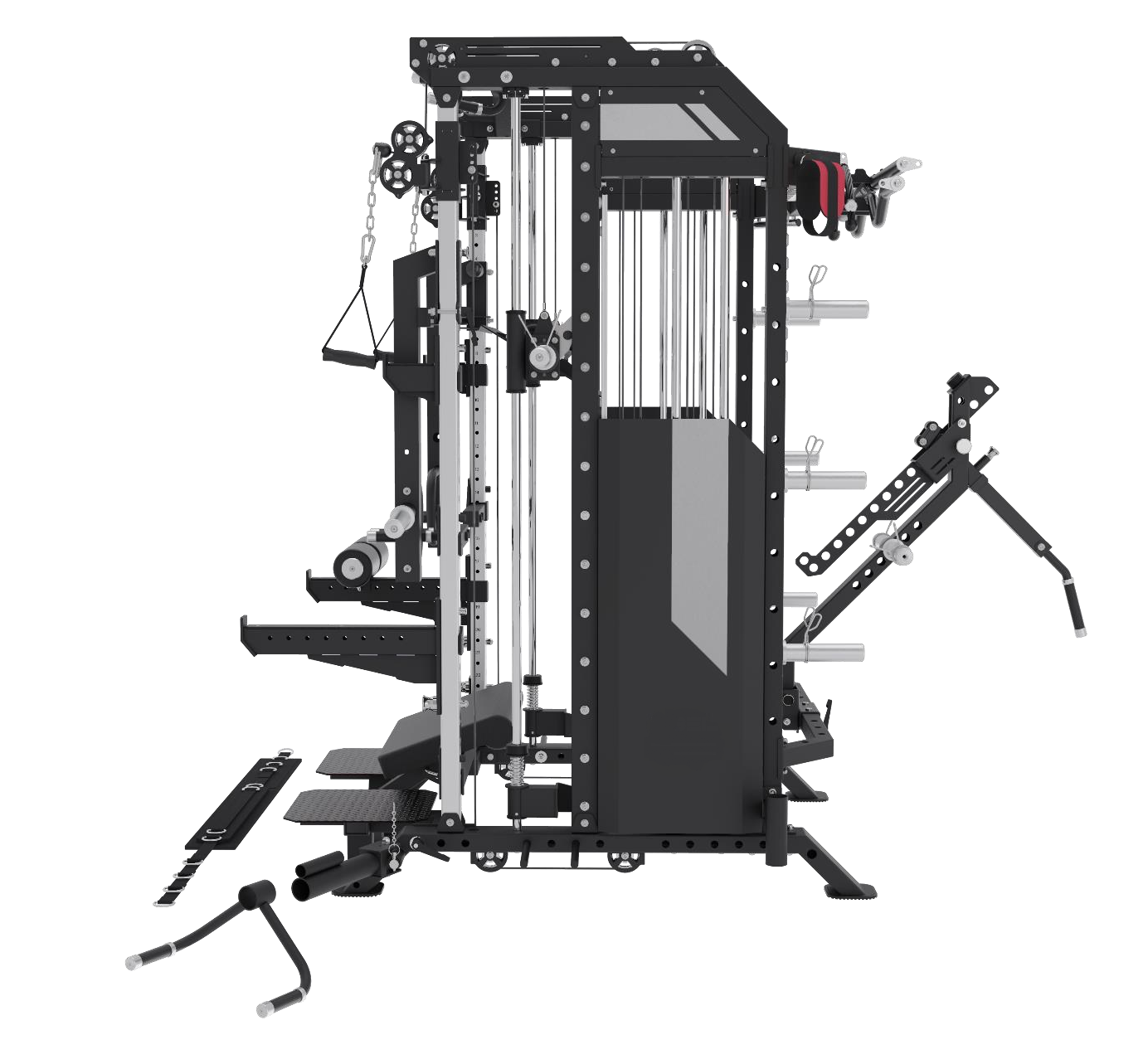
The Smith machine provides balance and stability, letting you load more weight without worrying about your footing. A great alternative when a dedicated standing calf raise machine isn't available. Trojan Fitness stocks a selection of Smith machines for home gym setups.
How to Perform:
- Set the bar at shoulder height and position it across your upper traps.
- Place a block or weight plate under the balls of your feet for range of motion.
- Unrack the bar and stand tall.
- Rise onto your toes as high as you can.
- Lower slowly and repeat.
- Perform 3–4 sets of 12–15 reps.
Form Tip: Don't let your lower back arch. Keep your core braced throughout.
5- Seated Dumbbell Calf Raise
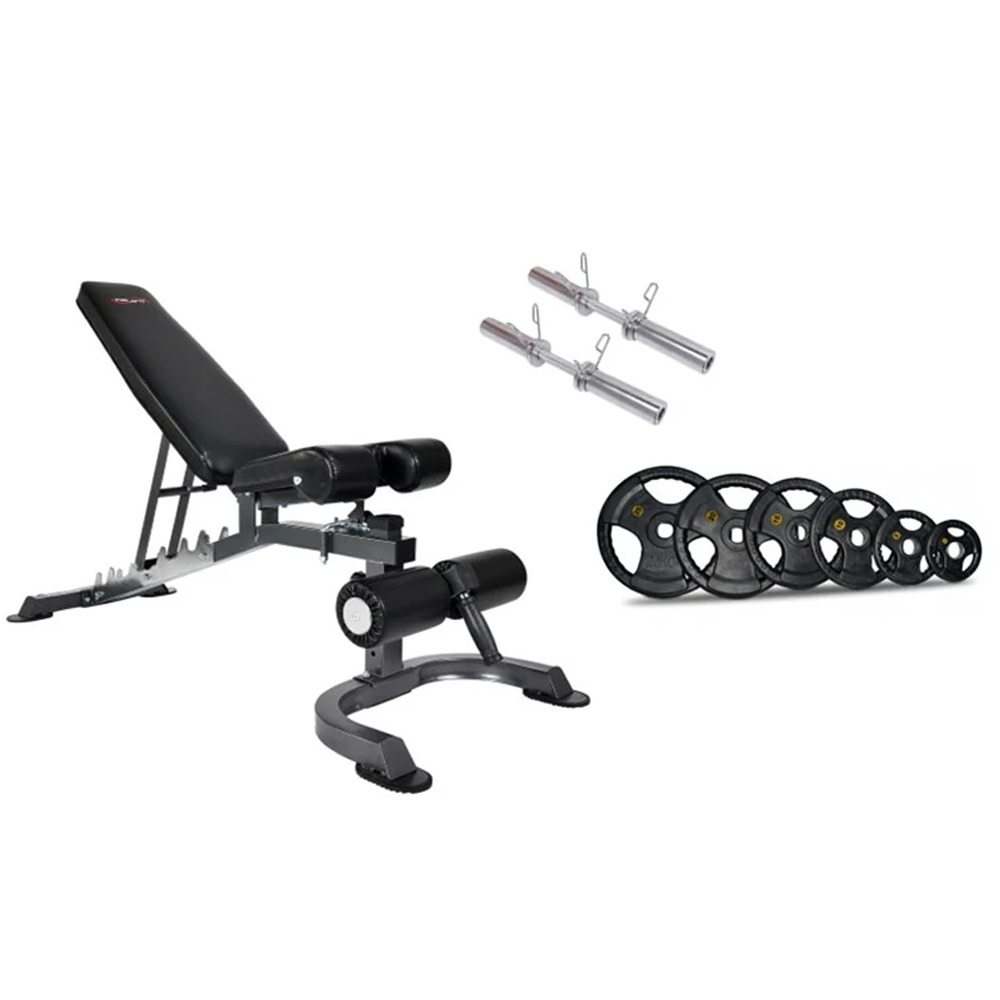
No seated calf raise machine? No problem. We have Seated Calf Raise Bench for you. This variation replicates the movement using a bench and dumbbells. You can also pick a pair from Trojan Fitness' range of dumbbells and dumbbell sets.
How to Perform:
- Place a step or block at the end of a flat bench.
- Sit on the bench and put the balls of your feet on the edge of the step.
- Rest a dumbbell on each thigh, close to your knees.
- Let your heels drop as far as possible toward the floor (without touching it).
- Drive your heels up as high as you can, squeezing at the top.
- Lower slowly back to the stretched position.
- Perform 3–4 sets of 15–20 reps.
Form Tip: Pause and squeeze for 1–2 seconds at the top to increase intensity and time under tension.
6- Standing Barbell Calf Raise
Add serious load to your calf training with a barbell across your back. This variation builds raw strength and size in the gastrocnemius.
How to Perform:
- Place a block or step in front of a squat rack.
- Unrack a barbell and position it across your upper traps (not your neck).
- Stand with the balls of your feet on the edge of the block.
- Rise onto your toes as high as you can, squeezing the calves.
- Lower your heels slowly. Go as low as your range allows.
- Perform 3–4 sets of 10–12 reps.
Form Tip: Keep your eyes forward at all times to maintain balance. Control the descent. Don't let gravity do the work.
7- Single-Leg Calf Raise
Training one leg at a time doubles the load on the working calf and corrects muscle imbalances between sides. It also challenges ankle stability and proprioception.
How to Perform:
- Stand on one foot near a wall or chair for balance.
- Rise onto the ball of your foot as high as possible.
- Lower slowly and with full control.
- Complete all reps on one side before switching.
- Perform 3–4 sets of 12–15 reps per leg.
Form Tip: If the movement is too easy with bodyweight, hold a dumbbell in the hand on the working side.
8- Donkey Calf Raise
This variation increases the stretch at the bottom of the movement by changing your hip position — making it excellent for deep gastrocnemius development. You can replicate this at home using a flat bench for support.
How to Perform:
- Hinge at the hips until your torso is roughly parallel to the floor.
- Rest your hands on a bench or raised surface for support.
- Keep your legs straight and perform a calf raise from this position.
- Rise as high as possible, then lower slowly.
- Optionally, have a training partner rest weight on your lower back for added resistance.
- Perform 3 sets of 12–15 reps.
Form Tip: The key to this exercise is keeping your hips high throughout. Don't let them drop as you fatigue.
9- Deficit Calf Raise
The deficit calf raise is the most range-intensive variation. Standing on a step or plate means your heels can drop significantly below your toes, maximising the stretch on both calf muscles and driving greater muscle activation.
How to Perform:
- Stand with the balls of your feet on the edge of a step or weight plate.
- Place your hands lightly on a wall for balance.
- Lower your heels as far toward the floor as you can; feel the full stretch.
- Press up onto your toes as high as possible.
- Perform 3–4 sets of 12–15 reps.
Form Tip: More range of motion = more muscle recruitment. Don't cut the range short by stopping at flat-foot level.
With your calf raise foundation covered across 10 targeted variations, it's time to bring in complementary exercises that challenge your calves through movement, power, and full-body loading.
2- Standing Calf Stretch

Recovery and flexibility are part of the process. This stretch targets both the gastrocnemius (straight leg) and soleus (bent leg) and should be done after every calf session.
How to Perform:
- Face a wall and place your palms flat against it at shoulder height.
- Step one foot back into a staggered stance.
- Keeping the back leg straight, slowly lean toward the wall; feel the stretch through the gastrocnemius.
- To shift the focus to the soleus, bend the back knee slightly so your heel just lifts off the floor.
- Hold each position for 20–30 seconds. Do 2–3 sets per leg.
3- Skiers

This movement builds resilience in the small intrinsic muscles of the foot, which work in direct partnership with your calves for ankle stability and balance.
How to Perform:
- Stand with feet together, knees and hips aligned.
- Lean your bodyweight forward from the ankles, not the waist, until you feel your toes gripping the floor and your heels starting to lift.
- Hold that tipping point without falling forward.
- Hold for 20 seconds. Do 5 sets.
Form Tip: This is a subtle, static exercise. The goal is controlled balance at the edge of your centre of gravity; not a dynamic movement.
4- Jump Rope

Jump rope is one of the most efficient calf-building tools available. It develops both power and endurance in the calves while delivering a cardiovascular benefit most weight-based exercises can't match.
How to Perform:
- Hold the rope handles and swing it over your head.
- Jump as the rope approaches your feet, landing on the balls of your feet; not flat-footed.
- Stay light, controlled, and consistent.
- Perform 4–5 sets of 1–2 minutes.
Form Tip: Start slowly and build pace. The calves take more impact than you expect, so ease into longer sets over several sessions.
5- Farmer's Walk on Toes

This carries multiple benefits at once; grip strength, core stability, and significant calf activation through sustained tiptoe walking under load. Use a pair of dumbbells or kettlebells from Trojan Fitness' weights range.
How to Perform:
- Grip a dumbbell in each hand and stand tall.
- Rise onto the balls of your feet.
- Walk forward in a straight line, staying on your toes throughout.
- Keep your core tight and your shoulders level.
- Perform 3–4 sets of 30–60 seconds.
Form Tip: Don't let your heels drop mid-set. If they do, reduce the weight or shorten the distance.
6- Single-Leg and Double-Leg Pogos

Pogos train the elastic, reactive quality of the calf. The kind of springy power that matters in sport, running, and agility.
How to Perform:
- Stand with feet together, arms at your sides.
- Rise onto the balls of your feet and hop continuously; small, quick hops.
- Keep knee bend minimal. The goal is to use your calves as the primary spring.
- Start with both legs, then progress to single-leg pogos for an added balance challenge.
- Perform 5–10 sets of 10 seconds per leg.
Form Tip: Think light and fast. If your knees are bending a lot, you're relying on your quads; not your calves.
7- A-Runs (High Knees)

A-runs develop quickness, lateral elasticity, and reactive calf strength. Ideal for athletes and anyone looking to build more functional lower-leg power.
How to Perform:
- Begin running in place with low knee drive.
- Progressively raise your knees higher until they come close to your chest.
- Pump your arms in sync with your legs.
- Perform 5–10 sets of 10 seconds.
Form Tip: The calves do the work of pushing you off the ground on each rep; focus on that push-off.
8- Box Jumps

Box jumps are a dynamic, high-intensity plyometric exercise that builds explosive power in the calves, quads, and glutes simultaneously.
How to Perform:
- Stand facing a plyometric box, feet shoulder-width apart.
- Drop into a quarter squat, then drive upward explosively.
- Land softly on the balls of your feet; absorb the impact through your legs, not with a hard flat-footed landing.
- Step down and reset between reps.
- Perform 3 sets of 10–12 reps.
Form Tip: Always warm up thoroughly before box jumps. Start with a lower box height and build progressively.
9- Sled Push on Toes

The sled push is a full-body conditioning tool that, when performed on your toes, places intense and sustained demand on the calves throughout every push.
How to Perform:
- Load the sled with a moderate weight and grip the handles.
- Rise onto your toes before you start moving, and stay on them.
- Drive forward in a powerful, controlled stride.
- Cover 20–30 metres per set. Perform 4–5 sets.
Form Tip: Keep your body angle forward and your core tight. The moment your heels drop, the calf stimulus drops with them.
10- Resistance Band Calf Press

The resistance band calf press is the ideal home-based calf exercise — zero equipment beyond a band, and highly effective for building both calf muscles through controlled resistance.
How to Perform:
- Sit on the floor with your legs extended.
- Loop a resistance band around the ball of one foot, holding both ends in your hands.
- Point your foot forward against the band's resistance (plantarflexion).
- Hold briefly at the peak contraction, then return slowly.
- Perform 3–4 sets of 15–20 reps per foot.
Form Tip: The slower the return, the more the calf muscles are forced to work against the band. Don't let the band snap your foot back.
Calf Exercise Safety Tips
Strong calves take consistent, smart training. Keep these principles in mind before and during every session.
-
Warm up first. Spend 5–10 minutes on light cardio or dynamic ankle circles before jumping into heavy calf work.
-
Stay hydrated. Water supports muscle function, flexibility, and joint cushioning. Especially important in Perth's warm climate.
-
Control your tempo. A slow count of 2–4 up, 4 down ensures maximum muscle tension without momentum doing the work.
-
Don't ignore pain. Soreness is normal. Sharp pain in the Achilles tendon or calf belly is not — stop and assess.
-
Seek guidance if you're new. A qualified trainer can confirm that your form and load selection match your current fitness level.
How to Build Calf Muscle Fast: Training Tips
-
Train Both Muscles: Combine standing and seated calf raises to target both the gastrocnemius and soleus for balanced growth.
-
Use a Full Range of Motion: Lower your heels fully and rise all the way up to maximise muscle activation and growth.
-
Train Consistently: Train calves 2–4 times per week to stimulate growth without overloading the Achilles tendon.
-
Apply Progressive Overload: Gradually increase weight, reps, or sets to keep challenging your calves and drive continuous growth.
Training Reference Table
|
Goal
|
Sets
|
Reps
|
Frequency
|
|
Size (hypertrophy)
|
3–5
|
10–15
|
3–4x per week
|
|
Strength
|
4–6
|
5–8
|
2–3x per week
|
|
Endurance
|
2–3
|
20–30
|
3–4x per week
|
Still training on flat ground and wondering why your calves aren't growing?
The exercises are only as effective as the equipment behind them.
Get the Right Calf Training Equipment at Trojan Fitness, Perth
Building strong, defined calves requires more than willpower; it takes the right tools. At Trojan Fitness, we supply Perth's home gym builders and serious athletes with professional-grade training equipment, from dumbbells and barbells to Smith machines, leg press machines, and weight benches.
Whether you're setting up your first home gym or upgrading your current setup, our team is here to help you find the right equipment for your training goals.
Shop Calf Training Equipment Online
FAQs
- How often should I train calves?
A good starting point is 2 to 3 calf sessions per week, with at least one rest day between hard sessions.
- Are calf raises enough to build calves?
Calf raises are the core exercise for calf development. Dumbbell calf raises are a simple, effective way to work the calf muscles. For more balanced growth, it helps to use different calf raise variations and add dynamic moves like jump rope or pogo-style hops.
- What is the best calf exercise machine?
The seated calf raise machine is excellent for isolating the soleus. The leg press machine is a strong choice for heavier calf loading. A Smith machine is also a useful alternative when you want stability during standing calf raises.
- Can I do calf exercises every day?
You can train calves often, but daily hard training is usually not the best idea. A better approach is to allow recovery between challenging sessions, especially if you are doing loaded raises or plyometric work.
- What causes weak calf muscles?
Weak calves can happen from disuse or muscle atrophy, which may be caused by inactivity, bed rest, poor nutrition, or nerve-related conditions. Diabetes-related nerve damage can also affect the legs and feet. So, if calf weakness is significant or getting worse, it is best to get checked by a healthcare professional before starting a training program.
Disclaimer:
The content on this blog is shared for general information only and is not meant to replace professional or medical advice. While we do our best to keep everything accurate and up to date, we can’t promise that all information is complete or fully reliable at all times. Any action you take based on this content is your own responsibility. It’s always a good idea to speak with a qualified professional before making major changes to your diet, workout routine, or lifestyle. We are not liable for any issues or outcomes that may come from using the information provided here.
 All Payment Methods are Accepted