Leg day isn’t for the faint-hearted people. And if you want bigger, denser quads, the hack squat must be in your program.
Hack squat exercise isolates the quadriceps, reduces spinal stress, and lets you safely push heavy loads for real hypertrophy. But only when it’s performed correctly. Poor setup or sloppy form can quickly turn a powerful quad builder into a knee- or back-stressing mistake.
That’s why our expert trainers put this guide together. You’ll learn exactly how to perform hack squats with proper form, optimal foot placement, and safe loading. Additionally, we’ll discuss the most effective variations for targeting quads, glutes, and hamstrings, and the common mistakes that limit results.
Struggling with long queues or overcrowded gyms? We’ve solved that too. With high-quality hack squat machines designed for home gyms, Trojan Fitness helps you build serious quad strength on your own terms — no waiting, no compromises.
Let’s start with the basics.
What is a Hack Squat?

A hack squat is a compound lower-body exercise performed using a hack squat machine or a barbell variation. It allows heavy leg loading while keeping the torso supported and upright, shifting emphasis toward the quadriceps and reducing strain on the lower back.
The hack squat started in early 1900s when George Hackenschmidt performed it for the first time. He lifted 187lb on his back with his knees bent and noted that it’s a great way to remove load from spine. The name “Hacke” meant “heel,” as barbell was placed behind the legs.
Fast forward, and the movement migrated to the machine you know today. An angled and guided weight lifting to hit the quads mercilessly. It lets you lift weight without any lower back strain or foot slipping.
Now, it’s helping young athletes to learn form, older athletes to rehab knees, and anyone to chase quad hypertrophy. The secret is just the correct form & consistency.
How to Do Hack Squat Properly
The hack squat is most effective when performed with precise setup, controlled tempo, and consistent form. Follow this clear, beginner-to-advanced step-by-step guide to maximise quad activation while minimising knee and lower-back stress.
Step 1: Set Up the Hack Squat Machine Correctly
Proper setup ensures spinal support, safe unracking, and the ability to re-rack instantly if you fatigue. Start with the machine adjusted to your body, not the weight.
- Load the sled conservatively. The machine itself is heavy, especially for beginners.
- Step onto the platform and press your back firmly against the backrest.
- Position your shoulders directly under the pads so they sit just below your shoulder joints.
- Adjust the safety hooks to the highest comfortable position for your height.
Step 2: Choose Your Foot Placement (Based on Your Goal)
Foot placement directly affects muscle recruitment:
-
Quad focus: Feet shoulder-width apart, placed lower on the platform
-
Balanced focus: Feet shoulder-width, mid-platform
-
Glute/hamstring focus: Feet slightly higher on the platform
Toes should point slightly outward, and heels must remain planted at all times.
Step 3: Unrack, Brace & Prepare
Push through your feet to stand tall and extend your legs. Pull the safety handles inward to disengage them. Then, take a deep breath into your abdomen and brace your core. Keep your chest upright, eyes forward, and lower back pressed into the pad.
Coaching cue: Brace like you’re about to absorb a punch; this stabilises the spine.
Step 4: Lower the Weight Under Control (Eccentric Phase)
Begin the descent by bending your knees, not your hips. Drive your knees forward in line with your toes. Keep heels grounded and your entire back in contact with the pad. Lower slowly for 2–4 seconds.
Depth guidelines:
-
For quads: descend until thighs are slightly below parallel
-
For glutes: stop around a 90-degree knee bend
Never bounce at the bottom of the movement.
Step 5: Pause & Drive Up Powerfully (Concentric Phase)
Pause briefly (0.5–2 seconds) at the bottom to remove momentum. Drive through your heels and mid-foot. Extend your knees smoothly while exhaling. Stop just short of locking out your knees at the top. This pause increases time under tension and boosts muscle growth.
Step 6: Re-Rack Safely After Each Set
Fully extend your legs at the top. Engage the safety handles before stepping off the platform. Never exit the machine without re-latching the sled.
Recommended Sets, Reps & Loading
-
Hypertrophy: 3–5 sets × 8–12 reps
-
Strength: 4–6 sets × 3–6 reps
-
Endurance / rehab: 2–3 sets × 15–20 reps
Increase load gradually (2.5–5 kg per side) only once flawless form is maintained.
Hack Squat Form: Technique, Foot Placement & Execution
Proper hack squat form ensures maximum quad stimulation while protecting the knees, hips, and lower back. Focus on these technique fundamentals every rep.
Essential Hack Squat Form Cues
- Chest upright, spine neutral, back fully supported
- Knees track in line with toes; never collapse inward
- Heels stay planted throughout the movement
- Controlled descent, smooth ascent
- Maintain tension; do not lock out knees at the top
Hack Squat Foot Placement
Adjusting foot placement changes muscle emphasis:
-
Low foot placement: Greater knee flexion → higher quad activation
-
Mid-platform placement: Balanced quad and glute involvement
-
High foot placement: Increased hip flexion → more glute and hamstring recruitment
Make small adjustments and test with lighter loads before progressing.
Hack Squat Form Mistakes (And How to Fix Them)
Even subtle mistakes can damage your rep-quality and compromise the results. It is important to control your motion, and always prioritise correct hack squat form to get results.
Watch out for these errors:
|
Mistake
|
Consequences
|
Potential Risks
|
|
Rounding the spine
|
Higher and potentially harmful compressive and shear forces.
|
Lumbar spine injuries, strains, and disc herniations.
|
|
Knees collapsing inward
|
Uneven pressure on the knee joint.
|
Irritation of the ligaments or cartilage.
|
|
Heels lifting off during descent
|
Compensation by full body weight instead of just target muscles.
|
Higher load on ankle joint.
|
|
Feet too low on platform
|
Increased knee flexion during the movement.
|
Stressing the patellar tendon.
|
|
Feet too high on platform
|
Move some of the load towards your glutes and hamstrings.
|
No harmful but quads are not solely targeted.
|
|
Using loads you can’t control
|
The body will compensate through surrounding muscles.
|
Serious injuries and muscle strain.
|
Hack Squat Muscles: Mapping the Gains

Elite 45 Hack Squat Machine 850lbs
Most lifters wonder, “What muscles do hack squats work?” Hack squats primarily target the quadriceps, with secondary involvement from the glutes, hamstrings, calves, and core depending on stance and depth.
|
Muscle
|
Primary Role
|
Activation Potential (1–10)
|
|
Quadriceps
|
Knee extension / main mover
|
9
|
|
Gluteus Maximus
|
Hip extension after halfway
|
7
|
|
Hamstrings
|
Stabiliser during descent
|
5
|
|
Calves (Gastrocnemius)
|
Foot stabilisation
|
4
|
|
Core
|
Bracing and stability
|
6
|
Small changes in foot placement, stance width, and squat depth can shift the emphasis between these muscles, allowing for a fully customised lower-body workout.
Customising Your Hack Squat for Different Muscles
Keep feet low on the platform. Maintain a shoulder-width stance. Squat deep, bringing your hamstrings close to your calves. Keep knees forward and lower back pressed against the pad.
Lower foot placement reduces hip involvement, increases knee flexion, and maximises quad activation.
Place feet higher on the platform. Use a slightly narrower stance if comfortable. Limit depth to a 90-degree knee bend. Lean slightly forward to engage glutes and hamstrings.
Higher foot placement increases hip flexion, activating glutes more effectively.
Feet higher and wider on the platform. Drive through heels and allow slightly deeper knee flexion.
Optional: Face the sled to enhance hamstring-glute synergy.
Brace your abs actively throughout the movement. Pause briefly at the bottom to build strength under tension.
Even small adjustments in foot placement, stance, or tempo can transform your hack squat session into a comprehensive leg workout.
Benefits of Hack Squat Exercise

These are the real, evidence-backed reasons to include hack squats in a plan for size, strength, or rehabilitation.
-
High quad isolation (hypertrophy-focused): The upright, guided sled increases knee travel and mechanical tension on the quadriceps. Great for building size.
-
Reduced spinal load: Back support lets you push heavier without the axial compression of a back squat. Useful for lifters with mild back sensitivity.
-
Stable, repeatable range of motion: Guided movement improves consistency, making it easier to train to technical failure safely.
-
Joint-friendly mechanics: The angled sled lowers shear and sudden loading; a solid option when managing knee or hip stress (with correct setup).
-
Safe progressive overload: The machine’s safety catches and fixed path let you add plates with less spotter-dependence.
-
Time-efficient quad work: Faster setup and fewer warm-up plate changes mean more effective time under tension per session.
If you’re not seeing benefits, double-check setup (foot placement, pad height, depth) and program variables (volume, frequency, load). If issues persist, consult a trainer or physiotherapist for individual adjustments.
Who Should Avoid Hack Squats?
Following are some cases where hack squat is prohibited.
- You have major knee, hip or ankle instability (see a professional).
- You’re recovering from spinal disc issues (avoid axial loading).
- You cannot limit movement to a controlled plane (start with bodyweight or leg press).
And remember, some people can respond differently to the same exercise. Test it, assess how your knees and back feel afterward, and adjust accordingly.
Hack Squat Comparison to Other Leg Exercises
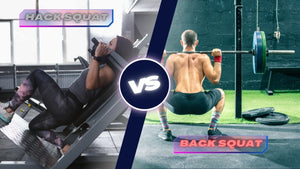
Hack Squat vs. Back Squat: Which Wins?
They’re different tools. The hack squat is a quad-dominant, machine-guided builder that reduces spinal load. The back squat is a full-body, free-weight lift that builds overall strength, stability and athletic transfer. Choose the one that matches your goal.
-
Hack squat: best for targeted quad growth, safer spinal position, and high-volume hypertrophy work.
-
Back squat: best for total-body strength, athletic performance, core stability and functional transfer.
Explore more details > Hack Squat vs Back Squat | Build Stronger Legs
Hack Squat vs Leg Press: What’s Different?
Leg press and hack squat both allow heavy leg loading with low spinal stress, but the leg press reclines you (more hip drive possible), while the hack squat keeps you more upright and increases knee travel for greater quad emphasis.
Key differences:
-
Body angle: Leg press ~45° reclined; hack squat = upright, back supported.
-
Range & mechanics: Leg press often allows deeper hip drive; hack squat increases knee flexion and quad demand (especially with low foot placement).
-
Stability & scale: Both are machine-guided, but leg press can allow more absolute load. Hack squat can feel more “squat-like” and better mimic standing mechanics.
Explore more details > Leg Press vs Hack Squat | Comparing Differences, Pros and Cons
Hack Squat vs Back Squat vs Leg Press: At a Glance
|
Exercise
|
Quad Focus
|
Lower Back Load
|
Stability Required
|
|
Hack Squat
|
High
|
Low
|
Low
|
|
Back Squat
|
Moderate
|
High
|
High
|
|
Leg Press
|
Moderate
|
Very Low
|
Very Low
|
The hack squat sits perfectly between the squat and leg press, offering heavy quad loading without excessive spinal stress.
5 Advanced Hack Squat Variations to Try
Want to progress beyond the basic machine hack squat? Use these targeted variations to break plateaus, build unilateral strength, and emphasise different parts of the legs. Below each variation you’ll find a quick how‑to, the main benefit, coaching cues, and programming notes.
-
Reverse (Face‑the‑Sled) Hack Squat
It shifts load toward glutes and hamstrings and changes the hip‑knee mechanics for a posterior‑chain emphasis. Here’s how to do it:
- Set the sled up as usual and step onto the platform facing the pad (so chest faces the sled).
- Position feet hip‑to‑shoulder width; higher foot placement emphasises glutes.
- Hook your shoulders under the pads, disengage the safety, and lower with control until knees reach 90° (or hamstrings parallel for your mobility).
- Pause, then drive through the heels to stand. Re‑rack safely.
Pro Tips: Keep the torso upright, brace the core, and avoid letting the knees travel too far past the toes. Stop if you feel pinching in the hips.
Programming: 3–4 sets × 6–12 reps for strength/hypertrophy.
No Machine? No Problem. Barbell hack squat requires minimal equipment, improves grip and posterior-chain coordination, and strongly targets the quads when heels are elevated slightly.
Here’s how to do it:
- Stand with a loaded barbell behind your calves. Use a pronated (overhand) grip.
- Drop into a controlled squat, keeping the bar close to the back of the legs.
- Drive up through the heels, keeping chest up and back flat. Pause and repeat.
Pro Tips: Keep the bar path close to the body; elevate heels on a small plate if you need extra ankle dorsiflexion.
Programming: 3–5 sets × 5–10 reps. Use lighter loads if you lack technical practice.
Mimics the machine hack squat’s guided movement and makes it simple to overload with confidence. How to do it:
- Set the Smith bar to shoulder height and stand with it resting on your upper back.
- Walk forward so your feet are in front of the bar (slightly different than a standard Smith squat).
- Squat until thighs are parallel, pause, and press up through the heels.
Pro Tips: Place feet to target your desired muscle (low = quads, high = glutes). Maintain a neutral spine and don’t lock knees at the top.
Programming: 3–5 sets × 6–12 reps.
The landmine provides stability while adding an anti‑rotational demand—great for unilateral control and beginner lifters. Here’s how to do it:
- Anchor one end of a barbell in a landmine. Clean the free end to one shoulder.
- Turn so your back faces the landmine, hold the free end with both hands, and step forward to a hip‑width stance.
- Squat down to parallel, pause, then drive up. Repeat and switch shoulders each set.
Pro Tips: Keep the torso tall, distribute weight evenly between both feet, and alternate sides to avoid imbalances.
Programming: 3–4 sets × 8–12 reps per side.
-
Single‑Leg / Alternating Hack‑Style Movements
This variation corrects imbalances, improves joint stability, and transfers to better athleticism. Here’s how to do it:
- Use a lighter load. Perform alternating step‑outs or single‑leg squat variations on the platform (or use a split‑stance Smith/landmine setup).
- Focus on equal reps per side and maintain steady tempo.
Pro Tips: Control the descent, don’t rush the drive, and keep hips level.
Programming: 3 sets × 8–12 reps per leg.
Level Up Your Leg Game with Premium Hack Squat Machines at Trojan Fitness
With quality equipment at Trojan Fitness, you can crush leg day at your convenience.
We offer you strong warranties, Australia-wide delivery, and expert installers. So, training at home become accessible for everyone. Our strength equipment match your ambition and supports your hustle, no queue required.
Grab yours & start dominating today.
Check Out Our Hack Squat Machines
Get in Touch with Us
Disclaimer:
The information provided on this website is intended for general informational purposes only and should not be considered professional or medical advice. We make every effort to ensure the information provided is accurate and up-to-date, but we cannot guarantee the accuracy, completeness, or timeliness of the information. Any reliance you place on such information is strictly at your own risk. Always consult a qualified professional before making any significant changes to your diet, exercise routine, or lifestyle. We are not responsible for any adverse consequences resulting from the use of, or reliance on, any information provided on this website.
 All Payment Methods are Accepted