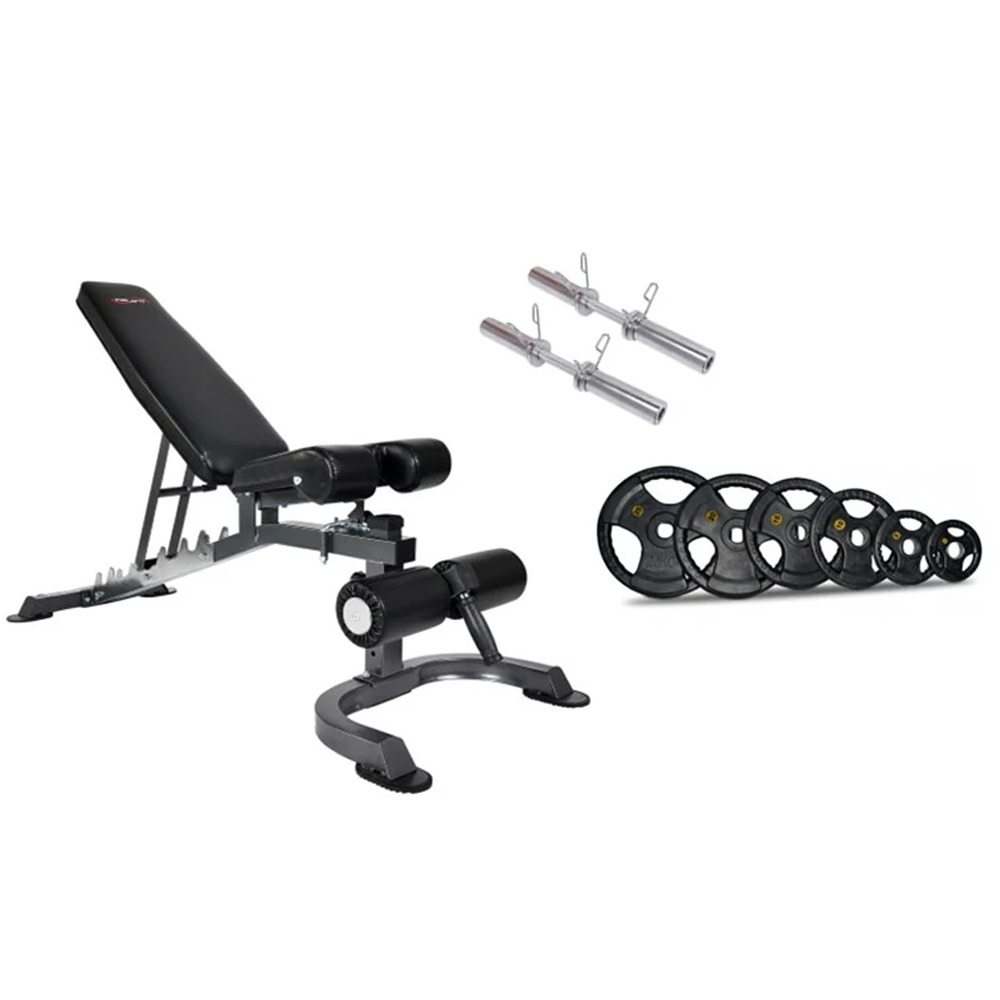
If you have a pair of dumbbells and a workout bench, you already own one of the most powerful strength-training setups for home workouts. With this simple combination, you can perform a wide range of exercises that build strength in your chest, back, shoulders, arms, legs, and core while improving stability and muscle balance.
In fact, many of the most effective exercises with dumbbells and bench can target multiple muscle groups in a single workout. From presses and rows to lower-body and core movements, this setup allows you to train your entire body efficiently.
So, in this guide, we’ll help you discover some of the most effective dumbbell bench exercises. You’ll also learn how to create a simple and practical workout routine using only two pieces of fitness equipment – a bench and dumbbells.
Keep reading to learn how to turn a bench and a pair of dumbbells into a complete and efficient strength workout.
9 Best Exercises with Dumbbells and Bench for a Full-Body Workout
A weight bench adds support and versatility to dumbbell training. It allows you to change angles, stabilise your body during lifts, and perform movements that are difficult to do on the floor. This makes it one of the most useful pieces of equipment for both home workouts and gym routines.
The exercises below combine compound movements, single-arm training, and core work to create a balanced full-body routine. With just a bench and a pair of dumbbells, you can build strength, improve stability, and develop muscle symmetry which is ideal for home gyms in Perth.
Let’s get into the most effective exercises you can start using today.
A staple horizontal press that builds chest strength and size. It demands greater shoulder stability than a barbell. Because each arm moves independently, dumbbells help correct imbalances and increase pectoral activation. This also works the triceps and front delts. Focus on a controlled descent and firm foot position to maximise force transfer and protect the shoulders.
Level: Beginner → Advanced
Muscles targeted: Pectoralis major, anterior deltoids, triceps; stabilisers — rotator cuff and core.
How to do it:
- Sit with a dumbbell on each thigh, then lie back and plant your feet.
- Bring dumbbells to chest level, palms facing forward.
- Retract shoulder blades and brace your core.
- Press both dumbbells up until arms are nearly straight (don’t lock).
- Lower under control to chest level, keeping elbows at a comfortable angle.
- Repeat with steady tempo.
Top tips:
- Keep wrists neutral and elbows slightly tucked.
- Maintain a slight lower-back arch and scapular retraction for shoulder safety.
- Control the eccentric (slow descent). It’s where most gains come from.
An upward-angled press that shifts emphasis to the upper chest and front delts. A modest incline (20°–35°) targets the clavicular pecs without overloading the shoulders; controlled eccentrics and a slightly tucked elbow position improve activation and reduce strain.
Level: Beginner → Advanced
Muscles targeted: Upper pectoralis major (clavicular head), anterior deltoids, triceps; stabilisers — scapular muscles and core.
How to do it:
- Set bench to 20°–35° and sit with dumbbells on your thighs.
- Lie back, plant feet, and bring dumbbells to upper-chest level.
- Press up and slightly together until near extension.
- Lower under control to the chest, keeping scapulae retracted.
- Repeat with a controlled tempo.
Top tips:
- Avoid inclines >40° (turns into a shoulder press).
- Keep elbows 45° from torso for safer shoulder mechanics.
- Use slow eccentrics to increase upper-chest tension.
-
Dumbbell Fly (Flat or Incline)
An isolation movement that stretches and shapes the chest by moving the arms in a wide arc. Flys emphasise pec lengthening and a finishing contraction; use lighter weights than presses and keep a small elbow bend to protect the shoulder joint.
Level: Beginner → Intermediate
Muscles targeted: Pectoralis major (stretch emphasis), anterior deltoids (secondary), rotator-cuff stabilisers.
How to do it:
- Lie on a flat or slightly inclined bench with dumbbells held above chest, palms facing each other.
- Keep a soft bend in the elbows and lower the weights in a wide arc until you feel a chest stretch.
- Bring dumbbells back together using chest contraction, not arm drive.
- Repeat with smooth, controlled motion.
Top tips:
- Prioritise range-of-motion and control over load as flys are about stretch.
- Keep elbow angle constant; don’t lock or dramatically bend the arms.
- If shoulders hurt, reduce range or replace with incline cable/band flys.
A unilateral (one-sided) pulling exercise that isolates the lats and mid-back while the bench stabilises the torso. It’s ideal for correcting left/right strength imbalances and building pulling strength without loading the lower back like heavy barbell rows can.
Level: Beginner → Advanced
Muscles targeted: Latissimus dorsi, rhomboids, middle trapezius, posterior deltoid, biceps, forearm stabilisers.
How to do it:
- Place one knee and same-side hand on the bench; the opposite foot stays planted.
- Hold a dumbbell with the free hand, arm extended beneath the shoulder.
- Keep a neutral spine and brace your core.
- Pull the dumbbell toward your hip, driving the elbow back and squeezing the shoulder blade.
- Lower slowly to full hang and repeat. Complete one side before switching.
Top tips:
- Pull with your elbow, not the hand. Think “elbow to hip.”
- Avoid torso rotation; stabilise with the core.
- Pause briefly at the top to improve mind-muscle connection.
-
Seated Dumbbell Overhead Press
A shoulder-dominant press performed seated with back support, which reduces lumbar strain and lets you focus on deltoid strength and pressing mechanics. Dumbbells allow a natural path and better shoulder stability than a fixed bar.
Level: Beginner → Advanced
Muscles targeted: Anterior & lateral deltoids, triceps, upper chest, core stabilisers.
How to do it:
- Sit upright on a bench with back support and feet flat.
- Hold dumbbells at shoulder height with palms forward (or neutral if stiff).
- Brace your core and press the weights overhead until arms are nearly straight.
- Lower under control to shoulder level and repeat.
Top tips:
- Keep a slight core brace; avoid overarching the lower back.
- Lead with the elbows slightly forward; safer shoulder mechanics.
- Use a neutral grip if you have shoulder discomfort.
-
Lying Dumbbell Triceps Extension (Skullcrusher)
An isolation movement for the triceps where the elbow is the primary joint in motion. Performed on a bench with dumbbells, it gives a larger range of motion than many machine variations and directly targets the triceps long head.
Level: Beginner → Intermediate
Muscles targeted: Triceps brachii (long, lateral, medial heads); secondary shoulder/forearm stabilisers.
How to do it:
- Lie flat on a bench, hold dumbbells overhead with arms extended.
- Keep upper arms steady and bend the elbows to lower the weights toward your forehead or just behind the head.
- Stop when elbows are 90°, then extend the arms to return to the start.
- Repeat with controlled tempo.
Top tips:
- Keep elbows tucked and fixed. No flaring.
- Move slowly on the descent to protect the elbow joint.
- If elbows hurt, reduce range or use single-arm variations.
A rear-foot-elevated single-leg squat that builds unilateral leg strength, balance, and hip stability. Elevating the back foot shifts emphasis to the front leg, making this one of the best dumbbell-and-bench moves for correcting imbalances and improving functional strength.
Level: Beginner → Advanced
Muscles targeted: Quadriceps, gluteus maximus, hamstrings, hip stabilisers, core.
How to do it:
- Stand 60–90 cm in front of a bench holding a dumbbell in each hand.
- Place the top of your rear foot on the bench.
- Keep torso upright, brace your core, and bend the front knee to lower until the front thigh is about parallel to the floor.
- Drive through the front heel to return to standing.
- Complete reps, then switch legs.
Top tips:
- Keep most weight on the front heel. Don’t push off the rear foot.
- Maintain an upright chest to emphasise quads; lean slightly forward to hit glutes more.
- Start light to master balance and tempo before adding heavy load.
A hip-dominant lift that targets glute strength and hip extension power. With the upper back supported on a bench, the hip thrust allows a large range of motion and high glute activation. It’s ideal for athletic performance and aesthetic development.
Level: Beginner → Advanced
Muscles targeted: Gluteus maximus, hamstrings, (secondary) quads, core stabilisers.
How to do it:
- Sit with your upper back against the bench and a dumbbell rested on your hips.
- Plant feet shoulder-width apart and brace your core.
- Drive through your heels to lift hips until your body forms a straight line from shoulders to knees.
- Squeeze glutes at the top, then lower under control.
-
Top tips:
- Drive through the heels and focus on a full glute squeeze at the top.
- Use a pad between dumbbell and hips for comfort.
- Avoid over-arching the lower back; the movement should come from the hips.
A compact seated core exercise that targets the rectus abdominis and hip flexors while challenging stability. It’s an excellent finisher to keep core tension after heavier lifts.
Level: Beginner → Intermediate
Muscles targeted: Rectus abdominis, hip flexors, obliques, stabilising core muscles.
How to do it:
- Sit on the edge of a bench, hands holding the sides for support, chest lifted.
- Lean back slightly and extend your legs with heels hovering.
- Pull your knees toward your chest, contracting the abs.
- Extend legs slowly without touching the floor and repeat.
Top tips:
- Keep the chest up and avoid rounding the lower back.
- Move slowly to maintain tension; don’t swing the legs.
- Advanced: hold a light dumbbell between the feet or add a pause at peak contraction.
Now that you know the nine most effective exercises with dumbbells and a bench, the next section will show you how to combine them into a simple full dumbbell and bench workout routine you can follow at home or in your gym.
Full Body Workout with Just Dumbbells and a Bench
Yes – it’s entirely possible to build an effective full-body workout routine using only dumbbells and a bench. With the right exercise selection and proper progression, this simple setup can help you train every major muscle group and develop a balanced physique.
A well-structured full-body workout targets the upper body, lower body, and core within the same training session. Dumbbells paired with a bench make this achievable by allowing you to perform a variety of movements from different angles.
By combining compound exercises, which engage multiple muscles at once, with isolation exercises that focus on specific muscle groups, you can create a balanced and efficient training program.
For example, this setup allows you to work different muscle groups effectively:
|
Upper Body Exercises
|
Lower Body Exercises
|
Core Exercises
|
|
Dumbbell bench press
One-arm dumbbell rows
Seated shoulder press
Bicep curls
|
Bulgarian split squats
Goblet squats
Step-ups
Romanian deadlifts
|
Bench leg pull-ins
Weighted sit-ups
Russian twists
|
One of the key principles behind muscle development is progressive overload. This refers to gradually increasing the demands placed on your muscles – whether by adding weight, increasing repetitions, or improving exercise intensity. Over time, this stimulus encourages the body to adapt, leading to stronger and larger muscles.
Dumbbells are particularly useful for progressive overload because they allow small weight increases and support a wide range of exercise variations that keep training challenging.
Of course, while a bench and dumbbells provide excellent versatility, they do have some limitations. Lifters who aim to develop maximal strength may eventually benefit from heavier equipment such as barbells. Similarly, certain movements like pull-ups or heavy squats can be harder to replicate with only dumbbells.
However, for beginners and intermediate lifters; especially those training at home, a dumbbell and bench setup can be more than sufficient to build strength, improve endurance, and support overall fitness.
Now that you understand how this equipment can train your entire body, let’s look at a complete dumbbell and bench exercise plan you can follow.
Complete Dumbbell and Bench Workout Plan (Beginner to Advanced)
The routines below are full-body workouts designed to be repeated multiple times per week. Each workout combines pushing, pulling, lower-body, and core movements so you can build strength, improve muscle balance, and increase overall fitness.
-
Beginner Dumbbell and Bench Workout
If you're new to strength training, start with lighter weights and focus on learning proper technique. Perform the following exercises in order.
Goal: technique, movement variety, base strength
Rest: 60–90s between sets
Time: 35–45 minutes
|
Exercise
|
Sets
|
Reps
|
Notes
|
|
Dumbbell Bench Press (flat)
|
3
|
8–12
|
Compound push — start session fresh.
|
|
One-Arm Dumbbell Row (bench-supported)
|
3
|
8–12 /arm
|
Compound pull — equalise left/right.
|
|
Romanian Deadlift (dumbbell RDL)
|
3
|
8–12
|
Adds posterior chain hinge (new).
|
|
Bulgarian Split Squat
|
3
|
8–10 /leg
|
Unilateral leg strength & stability.
|
|
Seated Dumbbell Overhead Press
|
3
|
8–12
|
Shoulder compound with back support.
|
|
Dumbbell Fly (light)
|
2–3
|
10–15
|
Isolation — chest stretch.
|
|
Bench Leg Pull-Ins (core)
|
3
|
12–15 or 30–40s
|
Core finisher.
|
Tip: Keep tempo controlled (2s down, 1s up) for beginners.
-
Intermediate Dumbbell and Bench Workout
At the intermediate level, increase both the resistance and total workload. You can also introduce slight variations such as incline presses or slower tempo repetitions.
Goal: increase volume and intensity, add variation
Rest: 60–75s (compounds) / 75–120s for heavier sets
Time: ~45–60 minutes
Program format suggestion (Full-body 3×/week): increase sets and add slightly heavier loads. Or split to upper/lower 4×/week if you prefer.
Full-body 3×/week sample:
|
Exercise
|
Sets
|
Reps
|
|
Incline Dumbbell Press
|
4
|
6–10
|
|
One-Arm Dumbbell Row
|
4
|
8–10 /arm
|
|
Romanian Deadlift (Dumbbell)
|
4
|
8–10
|
|
Bulgarian Split Squat
|
4
|
8–10 /leg
|
|
Seated DB Overhead Press
|
3–4
|
8–10
|
|
Dumbbell Hip Thrust
|
3–4
|
8–12
|
|
Dumbbell Fly / Rear-Delt Reverse Fly (alternate)
|
3
|
10–15
|
|
Bench Leg Pull-Ins or Weighted Sit-Ups
|
3
|
15–20
|
Tip: Alternate accessory focus across sessions (rear delt one day, fly the next) to avoid imbalance.
-
Advanced Dumbbell and Bench Workout
This version is designed for experienced lifters who want a demanding full-body session. The exercises can be performed as straight sets or in supersets to increase intensity and calorie burn.
Goal: higher weekly volume, targeted intensity, progressive overload
Rest: 45–75s for circuits, 90–180s for heavy sets
Time: 45–75 minutes
Option A — Advanced full-body (3×/week) — increase sets to 4–6 for major lifts.
Option B — Upper/Lower split (4×/week) — better for higher volume per muscle.
Advanced full-body sample:
|
Exercise
|
Sets
|
Reps
|
|
Dumbbell Bench Press (heavy)
|
4–5
|
4–6
|
|
Incline Dumbbell Press
|
3–4
|
6–8
|
|
One-Arm DB Row
|
4
|
6–8 /arm
|
|
Dumbbell RDL (heavy)
|
4
|
6–8
|
|
Bulgarian Split Squat
|
4
|
8–10 /leg
|
|
Dumbbell Hip Thrust
|
4
|
8–10
|
|
Lying DB Triceps Extension
|
3
|
8–12
|
|
Bench Leg Pull-Ins / Weighted Core
|
3
|
20–30s
|
Tips: use supersets (e.g., press / row) to increase density, or cluster sets for heavy doubles. Monitor fatigue and deload every 4–8 weeks. Evidence supports varied approaches; total weekly volume is key.
How Often Should You Do Dumbbell Bench Workout Each Week?
The routines are full-body workouts, meaning they train all major muscle groups in one session. Because of this, they should typically be performed:
|
Level
|
Recommended Frequency
|
Example Training Days
|
|
Beginner
|
2–3 workouts per week
|
Monday, Wednesday, Friday
|
|
Intermediate
|
3–4 workouts per week
|
Monday, Tuesday, Thursday, Saturday
|
|
Advanced
|
3–5 workouts per week
|
Monday, Tuesday, Wednesday, Friday, Saturday
|
Note: Always allow at least one rest or recovery day between intense sessions to help muscles repair and grow. Beginners should prioritise recovery. Advanced lifters may alternate intensity or muscle focus across training days.
Still struggling to build an effective home workout with limited equipment?
Level Up Your Training with Premium Home Gym Equipment at Trojan Fitness
You don’t need a garage full of gear to make real progress — you need the right kit and a plan.
Trojan Fitness provide premium fitness gear designed to help you train safely, progress consistently, and get real results from your workouts at home.
Our range of fitness equipment in Perth includes high-quality weight benches, dumbbells, strength machines, and essential training accessories. With durable construction, competitive pricing, and flexible financing options, we make it easier to create a workout space that supports your strength and fitness goals.
Shop Quality Fitness Equipment Now
FAQs
Can you work out with just dumbbells and a bench?
Yes, you can build an effective full-body workout using only dumbbells and a bench. This simple setup allows you to perform exercises that target the chest, back, shoulders, arms, legs, and core. Movements like dumbbell bench presses, rows, split squats, and hip thrusts provide enough variety to develop strength, muscle, and endurance without needing a full gym setup.
Can you build muscle with just dumbbells and a bench?
Yes, you can build muscle effectively using just dumbbells and a bench. By applying progressive overload – gradually increasing weight, reps, or training intensity – your muscles adapt and grow stronger over time. This equipment combination is particularly effective for beginners and intermediate lifters training at home.
Is a dumbbell bench press harder than a regular bench press?
A dumbbell bench press can feel more challenging than a barbell bench press because each arm works independently. This increases the demand on stabilising muscles and often provides a greater range of motion. While the barbell bench press allows heavier loads, dumbbells can improve muscle balance and overall strength development.
What muscles do dumbbell bench exercises work?
Dumbbell bench exercises primarily target the chest, shoulders, and triceps. However, depending on the movement variation, they can also engage the back, core, and stabilising muscles throughout the body.
How heavy should dumbbells be for bench exercises?
The ideal dumbbell weight depends on your experience level. Beginners usually start with lighter weights that allow 10–12 controlled repetitions. Intermediate lifters may use heavier loads for 6–10 reps. The goal is to choose a weight that challenges your muscles while still allowing proper form throughout the set.
Disclaimer:
The information provided on this website is intended for general informational purposes only and should not be considered professional or medical advice. We make every effort to ensure the information provided is accurate and up-to-date, but we cannot guarantee the accuracy, completeness, or timeliness of the information. Any reliance you place on such information is strictly at your own risk. Always consult a qualified professional before making any significant changes to your diet, exercise routine, or lifestyle. We are not responsible for any adverse consequences resulting from the use of, or reliance on, any information provided on this website.
 All Payment Methods are Accepted